Can I Use My Phone to Measure My Pupillary Distance?
9 MIN READ
By Pupillary Distance Team ·
Written by the team that builds the app, not by clinicians — how we research and source these guides.
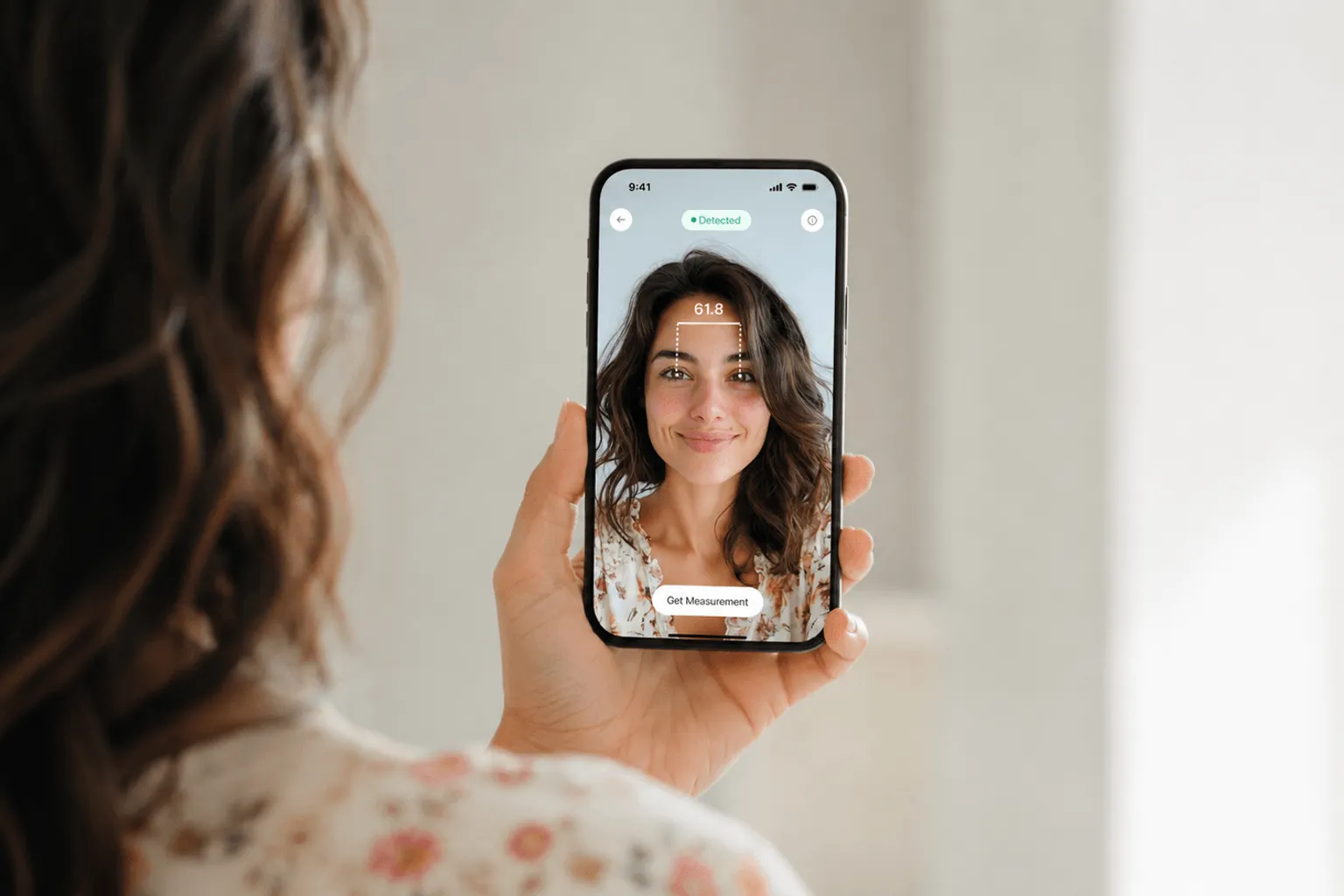
Yes — an adult can measure their pupillary distance (PD) with a phone, most easily with an app on an iPhone with Face ID, which measures the face in 3D with its TrueDepth front camera. In published studies, the better phone PD apps came within about half a millimeter of clinic measurements on average, but single readings could still be 2–3 mm off: close enough for everyday single-vision glasses, not for progressives, strong prescriptions, children or eyes that don’t line up.
Other phones can get there with a selfie and a bank card held to your face for scale, which works but leaves more room for error. We make an iPhone PD app, so weigh our pick with that in mind; the accuracy figures below come from independent studies of other apps, not ours.
There are four ways to get the number, and they suit different people:
- An app on an iPhone with Face ID reads your PD from a 3D model of your face. No card, no ruler, about a minute — and the better apps also give near PD and a value for each eye.
- A selfie with a card for scale works on any phone or laptop camera, and many online opticians offer one at checkout. It is only as good as the way you hold the card.
- A ruler and a mirror needs no phone at all, but people measuring themselves this way repeat to only about ±4 mm.
- An optician measures it in seconds with a pupillometer — the usual reference in the studies below — and is the right route for progressives, strong prescriptions and children.
What can a phone measure, and what can’t it?
A phone measures one thing well: the straight-line distance between the centers of your pupils, which is your far (distance) PD. Good apps add your near PD — about 3 mm smaller, for reading glasses — and a monocular PD for each eye, the distance from the bridge of your nose to each pupil.
How well a phone does it depends on whether it can measure depth. A flat photo has no scale: it cannot tell a large face far away from a small face close up. The TrueDepth camera on iPhones with Face ID — every iPhone since the iPhone X except the SE models — projects thousands of invisible dots and reads them back as a depth map of your face, so the millimeters are measured rather than guessed.
Phones without a depth camera, which means the iPhone SE and most Android phones, have to borrow the scale from something else in the picture. Usually that is a bank card held against your face, which is 85.6 mm wide by international standard. Some tools use your iris instead, on the assumption that irises are all the same size. They nearly are: Google’s iris-tracking research puts the horizontal iris diameter at 11.7 ± 0.5 mm across a wide population. But that ±0.5 mm is a ±4% scale error on its own — close to ±3 mm on a typical 63 mm PD.
Two things a phone PD measurement won’t give you:
- Fitting height for progressives and bifocals — where your pupil sits in the frame you have chosen. It varies from frame to frame, so it is measured with that frame on your face, not from your bare face.
- Your prescription. PD tells the lab where to put the center of each lens; it says nothing about the lens power you need. A PD app does not replace an eye exam.
How close does a phone get to an optician?
Closer than its reputation, on the published evidence — with a clear limit on what was tested.
| Study | What was tested | Compared with | What it found |
|---|---|---|---|
| Jung & Chu, 2024 — 40 adults | Eye Measure, an iPhone app | Clinical pupillometer | 0.6 mm average difference; 95% of readings between 2.9 mm under and 1.7 mm over |
| Han et al., 2023 — 44 adults aged 20–75 | Three App Store apps: Warby Parker, Eye Measure, PDCheck AR | Digital pupillometer | Average error about 0.5 mm for Warby Parker and Eye Measure, 1.4 mm for PDCheck AR |
| Farsi et al., 2026 — 90 adults aged 20–50 | The Warby Parker app | An autorefractor, and an examiner with a ruler | 0.4 mm average difference from the autorefractor, 98.8% of people within 2 mm; the authors still say app results should not be the only basis for clinical decisions |
| McMahon et al., 2012 — 52 participants | An early app on an iPod, and people measuring themselves in a mirror | Clinical pupillometer | The app was the least repeatable method tested, about ±6.5 mm; the mirror about ±4 mm |
Read the table in two layers. The averages, around half a millimeter for the better apps, say the method works. The spread is what matters for one person taking one reading: in the 2024 study, 95% of readings fell between 2.9 mm under and 1.7 mm over the pupillometer. That spread is why you take two readings, not one.
What these studies did not cover matters too: the three recent ones tested only adults, three of the four excluded people with a squint, and none tested our app. We make Pupillary Distance, and we have not run a formal test of it against a pupillometer, so the figures describe what phone apps have achieved, not a promise for ours. For the longer read — including why the 2012 result looks so different — see are pupillary distance apps accurate?
Option 1: an app on an iPhone with Face ID
The quickest route if you have the phone. You take your glasses off, hold the iPhone at the distance the app asks for in even light, look at the front camera, and the app reads the distance from its 3D model of your face. There is no card to keep flat and no eye to close.
Three things separate one app from another:
- What it reports. A single far PD covers ordinary distance glasses. Reading glasses need near PD; progressives and strong prescriptions need a monocular value for each eye. The app in the 2024 study gave no monocular PD at all.
- Whether it’s repeatable. Measure twice. If two readings from the same app disagree by more than about a millimeter, check the light and take a third.
- Where your face data goes. A PD app needs your camera. Check whether it keeps measurements on the phone or uploads them.
Our pick: Pupillary Distance for iPhone — we make it. It measures with the TrueDepth front camera, gives far PD, near PD and left and right monocular PD in one pass, and keeps every measurement on your iPhone: no account, no ads, nothing uploaded. It needs an iPhone with Face ID on iOS 16 or later, and it is free to download, with PD measurement part of a subscription. It is not one of the apps in the studies above, so measure twice and treat the result like any phone reading — right for everyday glasses, a starting point for progressives. Download it on the App Store.
The step-by-step, from opening the app to typing the numbers into a checkout, is in measure your PD online with your phone camera.
Option 2: a selfie with a card for scale
This works on any phone with a camera, and on a laptop webcam. Many online opticians offer a version: you take your glasses off, hold a card the size of a bank card against your face — under your nose for Warby Parker’s photo tool, any standard-sized card for Zenni’s — and the tool scales the photo against the card’s known width. Our guide to entering your PD at Zenni, EyeBuyDirect and Warby Parker covers what each one asks for.
It works, but it inherits every error in how you hold the card. Tilted, not quite touching your face, or sitting in a different plane from your pupils, and the error goes straight into the result. We found no independent, peer-reviewed test of these card tools against a pupillometer, so we cannot put a number on them. If you use one, take three readings and check them against each other — and against a ruler.
A plain selfie with no card cannot give you millimeters on its own. A tool that skips the card is estimating the scale from your face, for example from the size of your iris, which brings back the ±4% problem above.
Without a phone: a ruler or an optician
A ruler and a mirror costs nothing. Stand about 20 cm (8 in) from a mirror, hold a millimeter ruler against your brow and read from one pupil to the other, one eye at a time. Expect a spread: in the 2012 study, people repeated their own mirror measurement only to about ±4 mm, so measure three times and average. The printable PD ruler prints at true size, and how to measure your pupillary distance walks through the mirror and friend methods.
An optician measures it in seconds with a pupillometer, the instrument most of the studies above use as their reference. If you are having an eye exam anyway, ask for your PD to be written down — it is often missing from a prescription, because it is a fitting measurement rather than part of the exam.
When is a phone not enough?
In four cases, each for a reason the evidence supports:
- Progressive or bifocal lenses. They need a monocular PD for each eye and a fitting height measured in the frame you have chosen. An ophthalmologist answering for the American Academy of Ophthalmology notes that progressives in a high plus or minus power can be problematic if the PD is off by a small amount.
- A strong prescription. An off-center lens acts as a prism, and the prism grows with lens power: 3 mm off a −1.00 D lens gives about 0.3 prism diopters, the same 3 mm off a −5.00 D lens about 1.5. A phone’s 2–3 mm worst case matters far more there — does PD matter? has the details.
- A child. None of the recent studies included children, and a child’s PD keeps growing. Our guide to children’s PD recommends letting the dispensing optician measure it every time you order.
- Eyes that don’t line up. All three studies that report it excluded people with a squint (strabismus), and the 2024 study’s authors advise caution with misaligned eyes. If you have one, have an optician measure your PD.
How do you check a phone measurement?
- Measure twice. Two readings from a good app should agree closely. If they don’t, take your glasses off, find even light, hold still and measure again.
- Check the range. Most adults fall between about 50 and 75 mm, averaging around 63 mm. The PD calculator compares your number with the published adult distribution; a result outside the range is a reason to measure again, not proof of a problem.
- Check near against far. Near PD runs about 3 mm below far PD. A much bigger or smaller gap suggests a slip.
- Check that the per-eye values add up. Left plus right monocular PD should equal your far PD.
- Compare with an old number. An adult’s PD does not meaningfully change, so a number from an optician or a past order should still be close.
In one line
Yes: the better phone apps land within about half a millimeter of a clinic measurement on average, a card selfie gets you an estimate, and progressives, strong prescriptions, children and squints still belong with an optician. On an iPhone with Face ID, Pupillary Distance is ours.
Frequently asked questions
Keep reading
Pupillary Distance for Kids: Average PD by Age
Pupillary distance for kids: average PD by age and sex from published growth equations, why a child's PD has a shelf life, and who should measure it.
Is Pupillary Distance the Same as Axis?
Is pupillary distance the same as axis? No — PD is in millimeters, axis in degrees. Why the two get confused on a prescription, and what a mix-up does.
4.4★ · 310+ Reviews
Your PD, measured in under a minute.
Pupillary Distance turns your iPhone into an accurate PD meter. Measure once, then order glasses online with confidence.